
“Stories are our primary tools of learning and teaching, the repositories of our lore and legends. They bring order into our confusing world.” –Edward Miller
“Poetry lifts the veil from the hidden beauty of the world, and makes familiar objects be as if they were not familiar.” –Percy Shelley
Stories matter. God doesn’t give Scripture to us in the form of a cookbook, a mathematics or science textbook, or a dictionary. He gives us stories. A few years ago, we hosted Dr. Junius Johnson through the Eliot Society who discussed “The Imagination at the Heart of Discipleship,” a reminder that the Christian life is not one of legalistically checking off boxes, but as an imaginative exercise in which we discern how we can incarnate Christ in the contexts that we occupy. If stories are the way we as humans learn and teach, then in behooves those of us who are clergy and who have been formally commissioned to “teach the people committed to your Cure and Charge” (BCP 542), to not only engage with stories that point us to what is true, beautiful, and good, but also to invite others to do the same.
And so, I would like to recommend to all of you Galahad and the Grail, an epic poem by Malcolm Guite. This volume is the first of four installments in his Arthuriad (you can see him discussing the proofs of volume two in the video off to the side). Many of us may be familiar with the Arthurian legends which have been transmitted across many generations, sometimes for better, sometimes for worse. Fortunately, Guite’s book is a most welcome continuation of this tradition in which he admirably responds to the call of the angelic Muse who sings to him at the beginning of the poem:
And with the music came these words:
“Poet, take up the tale!
Take up the tale this land still keeps
In earth and water magic sleeps
The dryad sighs, the naiad weeps
But you can lift the veil.”
The Arthurian legendarium is the founding myth of the British people. Like any founding myth, it is evergreen, an important source to return to because its meaning continues to unfold across time and space. As Anglicans, we can trace are faith back not just to the Church of England—the institution created by the English Reformation—but to the British Church that long predates the Reformation itself. As such, the Arthurian legends can speak to the whole Church Catholic, and especially to us who occupy the Anglican branch of the greater Tree. But beyond our particular denominational interests, Sir Gawain is a story worth reading. This is one of those rare books that can speak to anyone: a retired adult, a college student, a whole family, or even a student in elementary school. It is able to cut across these various demographical sections precisely because it touches on things that are transcendental. Poetry has a way of putting words to the sublime and is, therefore, an effective means of communicating the incommunicable. And that’s what Guite does in his iteration of the Arthurian tales! Guite’s retelling of Gawain offers us a clear vision of chivalry and virtue in a world that is often so painted in gray and moral ambiguity that it is difficult to find a north star. The book offers us beauty in a world that is increasingly overwhelmed by AI slop. The book offers us a picture of God and how he works in the world, despite the fact that we tend to be too caught up in scientism to see him.
The love of beauty isn’t just found in the words of this edition, however. The aesthetics of the book are quite impressive.
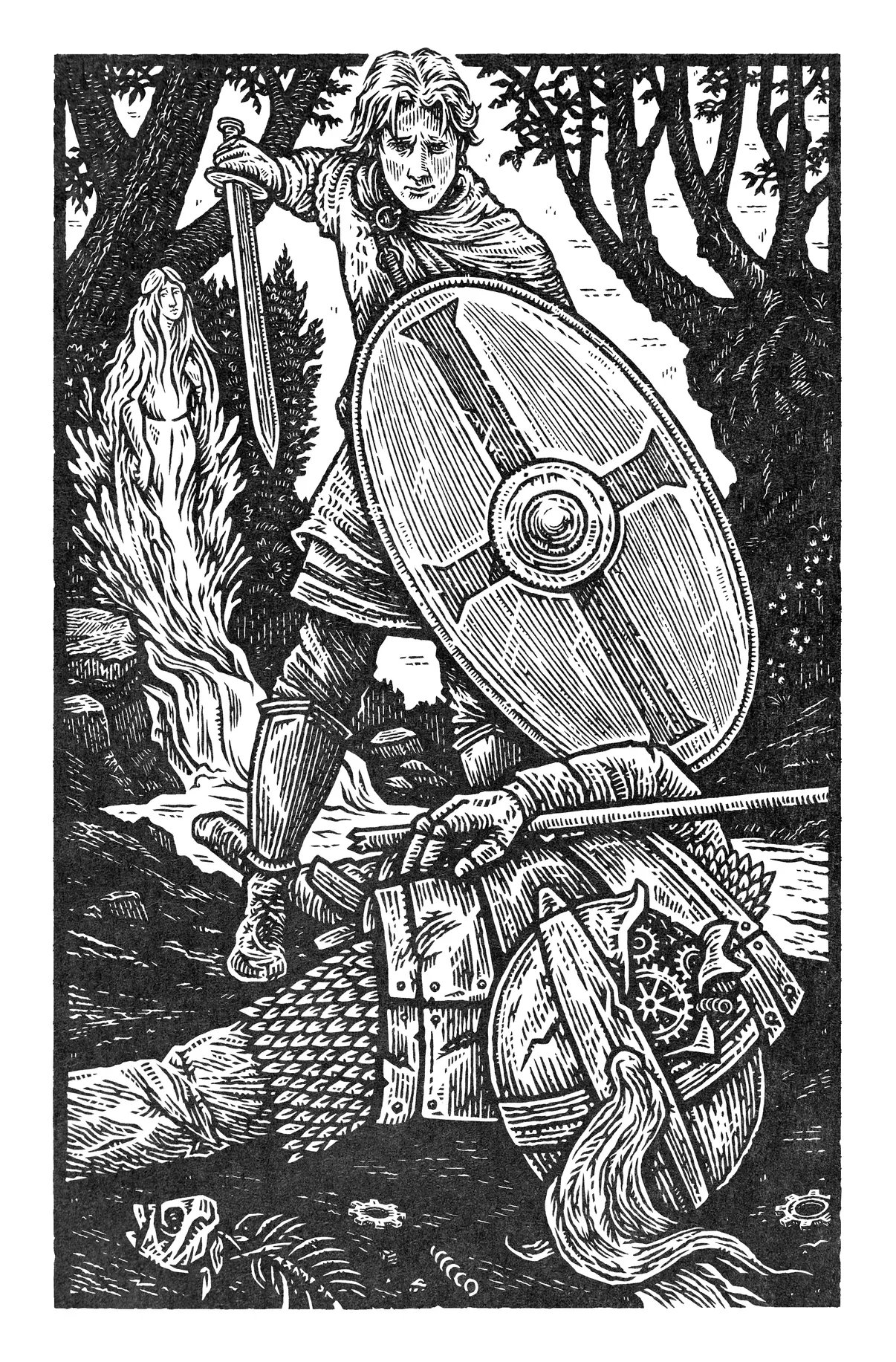
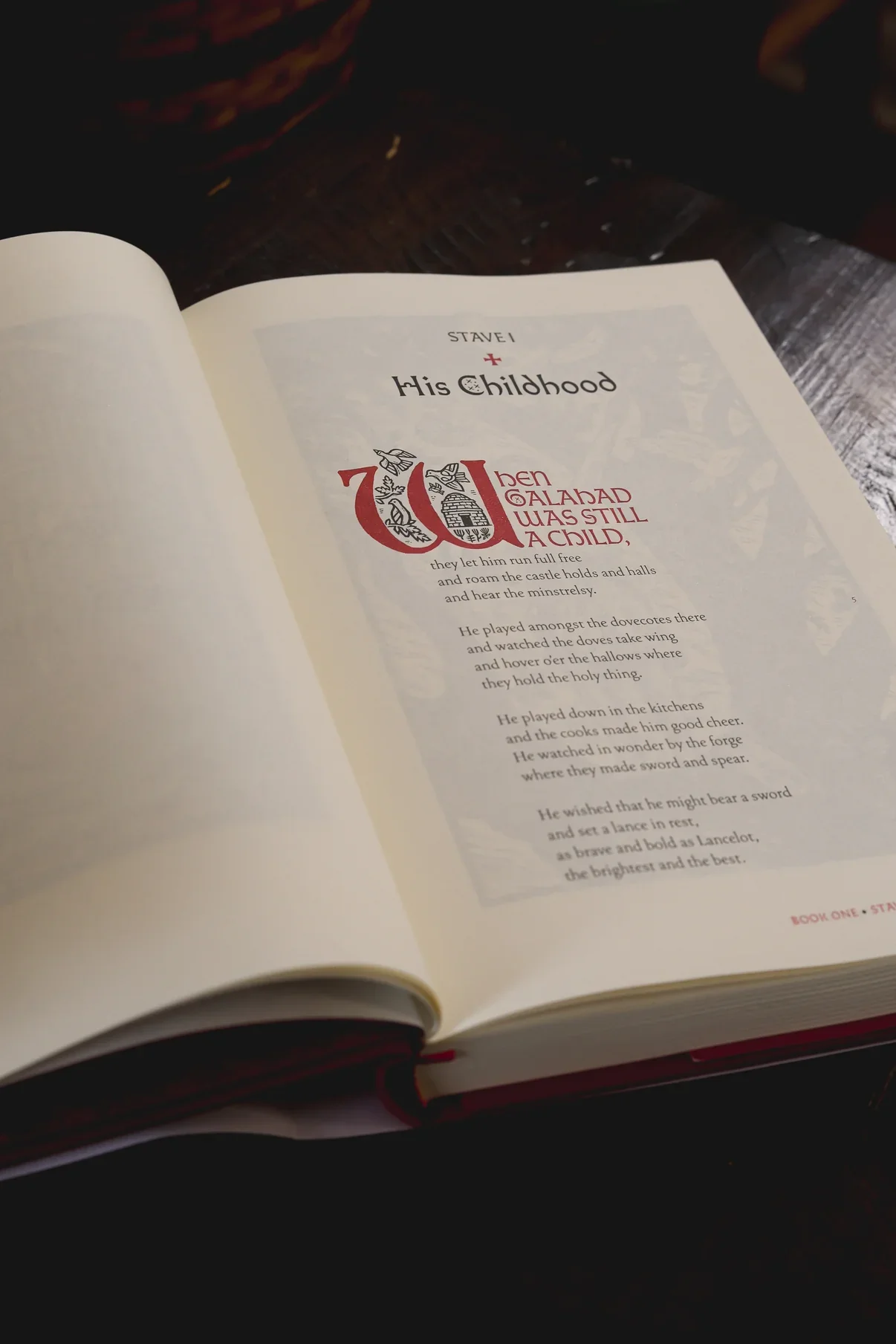
The art is made by an artist named Stephen Crotts who does an excellent job visualizing Guite’s poetic world. The pages are clean so that the text can speak for itself. It is elegantly befitting of the material it bears.
Finally, a word should be said about Malcolm Guite. He is an Anglican priest and a poet who carries the Anglican tradition of poetry—the tradition of George Herbert, John Donne, Christina Rossetti, T.S. Eliot—into the modern era. It’s not an understatement to say that he might be one of the greatest living poets. Beyond Galahad, his work is worth checking out. So if you’re looking for some poetry to incorporate into your reading rotation, consider acquiring any of thte following: